Most of the websites I build for clients have the same needs: they must load fast, rank well, be easy to update, and occasionally talk to a database. The Next.js App Router covers all of that without stitching together half a dozen tools.
Less JavaScript by default
Components are server components unless you opt out. A page of text, images and links ships almost no JavaScript, and only the interactive pieces (a form, a menu, a carousel) become client components with "use client". Visitors on slower phones notice the difference.
SEO without plugins
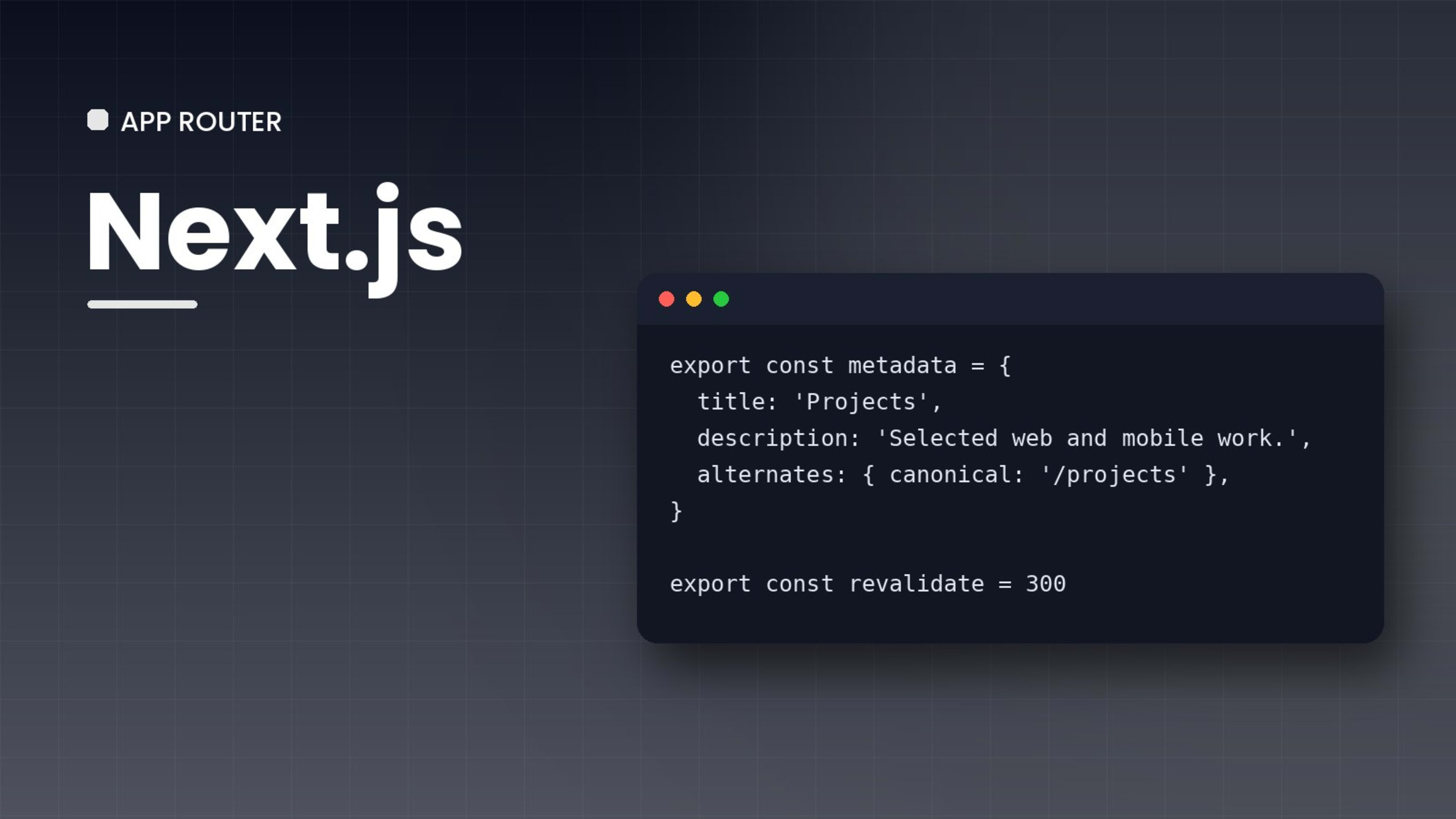
Each page exports its own metadata:
export const metadata = {
  title: 'Projects',
  description: 'Selected web and mobile work.',
  alternates: { canonical: '/projects' },
}
Add sitemap.js, robots.js and an opengraph-image file and the essentials are covered, generated from the same source of truth as the pages.
The right rendering for each page
Not every page needs the same strategy:
- Static for pages that rarely change, like About and Services.
- Revalidated for content that updates occasionally, like a blog list that refreshes when a post is saved.
- Dynamic for anything personal, like a dashboard or a page that knows who is signed in.
You choose per route, not per project.
Server actions for forms
Contact forms, quote requests and admin edits can call a server function directly. Validation, database writes and authorisation checks all run on the server, and there's no separate API layer to maintain for simple sites.
The trade-off
The App Router has a learning curve, and the line between server and client code takes some getting used to. For content-led business sites, though, the result is faster pages and less code, and that's what clients are paying for.
Comments (0)
No comments yet. Start the conversation.
Join the conversation
Sign in or create a free account to comment.